
Lyon County Projected vs Actual Release
KDOC calls its public forecast the Anticipated Release Date. It is part of the official state sentence computation for a person in Kansas corrections. The field is not a promise that the person will walk out on that day. Earned credits, forfeitures, restored credits, corrected orders, or another hold can move it. The actual release is the custody transaction recorded when the responsible agency processes the person out or transfers custody.
A Lyon County pretrial detainee is different. Bond, dismissal, a court order, or resolution of all holds controls release, so the live jail record may have no set future date. A transfer to KDOC or another authority is not community release.
The distinction also matters after prison. K.S.A. 22-3717 provides that a person under the determinate framework moves to postrelease supervision when the prison portion ends. Leaving the institution is therefore not the same as full sentence discharge. KASPER’s current status and later discharge information help separate those stages.
| Situation | Where the date comes from | What to verify |
|---|---|---|
| Pretrial county custody | Court and bond events | All holds and the jail transaction |
| County jail sentence | Judgment, jail credit, and sheriff calculation | Court order and jail records |
| Kansas prison sentence | KDOC sentence computation | KASPER and KDOC |
Find Lyon County Projected Release Dates
Begin by identifying the custodian. For a sentenced state prisoner, use the official KASPER search. KDOC says KASPER includes sentence data, movements, supervision information, and the Anticipated Release Date. It updates on weekdays. For someone at the Lyon County Detention Center, call 620-341-3205 and check the court order instead.
- Match the person by full name and KDOC number when available.
- Confirm that the conviction and identity fields belong to the right person.
- Read current status, location, sentence fields, and Anticipated Release Date together.
- Check movements and supervision fields so a transfer is not mistaken for community release.
- For a county case, compare the journal entry, jail credit, bond status, and every active hold.
- Confirm the completed event with the holding agency.
The broader Lyon County released inmate search explains how to combine the jail release record with court, VINE, KDOC, and federal sources.
KDOC’s official description of KASPER release-date fields appears in its resident-location guidance.

The state source warns that the anticipated date can change as credits are earned or lost.
KASPER should be read as a set of connected fields. A date without the current status can be misleading. Movement history may show that a person left one institution but entered another. The supervision office can show that institutional custody ended while KDOC community supervision remains active. For an exact computation question, contact KDOC with the KDOC number and sentence details rather than asking the county jail to interpret a state prison term.
Kansas Credits Shape Lyon Release Dates
For many guidelines crimes committed on or after July 1, 1993, K.S.A. 21-6821 generally limits good time to 15% of the prison part of the sentence. That supports the common shorthand that about 85% may be served if all available credit is earned and kept. It is not a universal rule. The statute permits up to 20% for specified lower-severity crimes within stated date ranges, and it authorizes program credits for qualifying cases under statutory caps and KDOC rules.
Consider a simplified example, not a prediction. A 100-month prison portion with a 15% maximum could allow as much as 15 months to be subtracted from institutional time if the credit is earned and retained. That leaves about 85 months before postrelease supervision. Jail credit, concurrent or consecutive cases, discipline, program credit, corrected journal entries, detainers, and offense-specific rules can change the actual result.
The governing statute can be reviewed in the source image below.
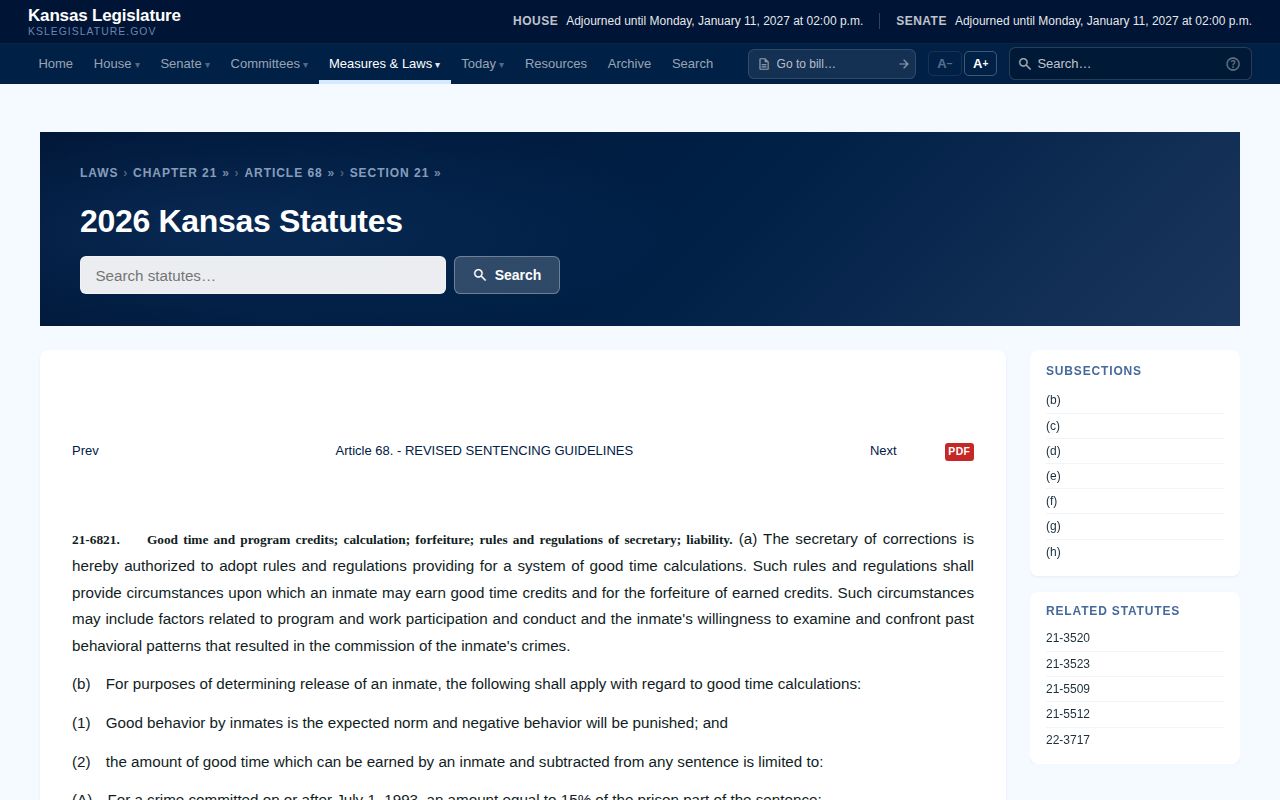
The statutory text, sentence documents, and KDOC computation must be read together for an individual date.
Some offense-specific provisions work differently. Certain sexual-offense sentences can add earned or subtracted prison time to the postrelease term instead of making that time vanish from the overall structure. Program credits also apply only to qualifying severity levels and remain subject to statutory caps and KDOC rules. These exceptions are why an online calculator or a simple percentage cannot replace the official computation.
Credits are not all the same. Good time concerns conduct and the governing sentence rules. Program credit depends on authorized participation and statutory eligibility. Jail credit comes from qualifying time already spent in custody and is reflected through the sentencing process. Combining these labels into one guessed deduction can produce a false date. Read the journal entry first, then compare KDOC’s current computation and public Anticipated Release Date.
Why Lyon Release Dates Change
A forecast changes when the legal or credit inputs change. Some changes move the date forward, while others move it back or redirect custody to another agency. The public field may also trail the underlying event until KDOC’s next weekday update.
| Factor | Possible effect |
|---|---|
| Good-time or program credit | Earned, withheld, forfeited, or restored credit changes the computation |
| Corrected sentence | A revised journal entry can alter the controlling term |
| Jail credit | Credited pre-sentence time changes remaining prison time |
| Concurrent or consecutive cases | Sentence aggregation changes the endpoint |
| New conviction or revocation | Additional custody can extend or restart confinement |
| Parole decision | A grant, denial, deferral, or rescission affects an indeterminate case |
| Detainer or transfer | One release may become continued custody elsewhere |
A detainer is a request or order from another authority to hold or transfer a person. It can prevent community release even when one sentence reaches its expected date.
Parole decisions apply to covered indeterminate cases, not every Kansas prisoner. A grant can still be followed by later action before release, including rescission in suitable circumstances. A denial or deferral can move the next review point. The Prisoner Review Board’s public-comment list is prospective and does not function as a decision-results database.
Confirm Lyon County Release Dates
Use Kansas VINELink for a custody-change alert when the correct agency record supports registration. A VINE alert is a prompt to verify, not the final sentence calculation. Contact KDOC for a state sentence-computation question and the Lyon County jail or court for a local jail calculation.
Once release occurs, compare the actual movement or release event with KASPER’s current status. “Postrelease supervision” means the prison portion ended but the sentence has not fully discharged. A later discharged status marks a different stage. These distinctions keep a departure from prison from being described as the end of all legal supervision.
For a county release, request the existing booking and release-log entry if a precise time or transfer destination matters. Kansas open-records law does not require an agency to create a custom calculation that it does not keep. Ask for the existing document, identify the person and date range, and request an advance fee estimate.
The court path depends on the charge. State-law felony and misdemeanor matters filed in Lyon County belong in the Fifth Judicial District. Emporia city-ordinance cases use Emporia Municipal Court. A person held at the same county facility can have records in either court, and multiple cases can create separate release barriers. Check every known case before assuming one satisfied bond or sentence controls the final date.
Older Lyon County Sentence Dates
Crimes committed before July 1, 1993 can follow an indeterminate parole and conditional-release framework. K.S.A. 22-3725 contains a good-time table for qualifying older crimes, while K.S.A. 22-3717 governs parole eligibility and hearings.
Eligibility is not release. The Prisoner Review Board still decides suitability in covered cases. A listed possible-release month or parole hearing does not prove a grant, and no stable comprehensive public decisions database was verified. Check KASPER and the Board’s official process.
The older-sentence table appears in the official source below.
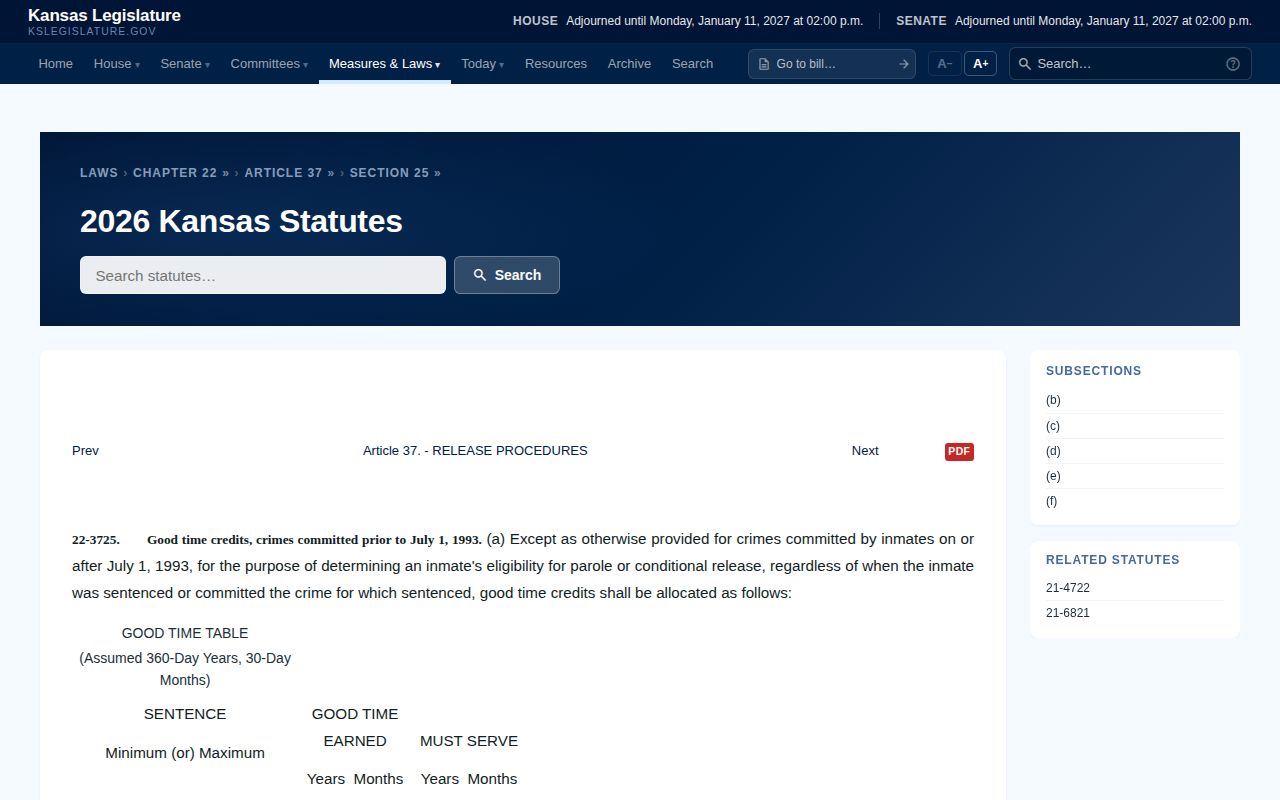
This table should be applied only to a qualifying sentence, never as a general county release formula.
The Board’s public-comment calendar can identify an approaching parole-eligibility process and a possible later release month. That month is not a final release date. Public comment occurs before the actual hearing, and the Board can grant, deny, defer, or later rescind release in suitable circumstances. Confirm the outcome through KASPER or the Prisoner Review Board’s official records route.
Lyon County Jail Date Calculations
The state 15% or 20% limits should not be pasted onto a Lyon County jail sentence. A judge’s sentence and jail-credit order, bond order, and the sheriff’s execution of those orders control. No published Lyon County jail good-time policy or weekend-release rule was verified.
Ask the court clerk for the controlling journal entry and ask the Detention Center which public record shows the calculation or processed-out event. Also check for holds. This local computation path is more accurate than subtracting a guessed credit percentage from the headline sentence.
A bond amount or signed order alone does not prove that release processing finished. Staff must complete the custody transaction, and another warrant or detainer may remain. Likewise, a person who disappears from the current jail search may have transferred. Call the jail and compare the court record before treating the absence as an actual community release.
Timing questions should be framed around records the agencies keep. The court can supply the signed sentence, bond order, or later modification. The sheriff can supply the jail’s public booking and release transaction. KDOC can address a state sentence computation tied to a KDOC number. Each source has a different role. Asking the county jail to recalculate a KDOC sentence, or asking KASPER to predict a local bond release, crosses those roles and is likely to produce an incomplete answer.
No fixed Lyon County release hour, exit door, weekend practice, or transportation arrangement was found in the official sources. Call the Detention Center for same-day logistics. Do not convert an anticipated date into a promised pickup time.
- Good time
- Credit that may reduce institutional time when earned and retained under the governing rule.
- Jail credit
- Time a court credits toward a sentence for qualifying prior custody.
- Postrelease supervision
- Community supervision that follows the prison portion of many determinate Kansas sentences.
- Discharge
- The formal completion of the sentence or supervision term.
Public Record Search
Sponsored Results